Eurener vs. Aiko: comparing two solar panels from across the world
Solar panels are often considered by homeowners looking to cut their energy bills, increase the value of their property, or live more sustainably. With the number of panels on the market and the knock-on complications in the installation process that could be caused by changing between different panels, it can be difficult to compare solar modules and choose which is a good fit for you.
Around 80% of all solar panels are manufactured in China, including market leaders in terms of efficiency and power. However, panels closer to home are available, particularly from European manufacturers such as Eurener, which has worked in solar since 1997. Intuition might lead us to assume that European panels could offer higher quality at a premium price, but is this really the case? In this article, we compare similar panels from solar companies Aiko (Chinese) and Eurener (Spanish), both on their datasheets and in a real-world system design.
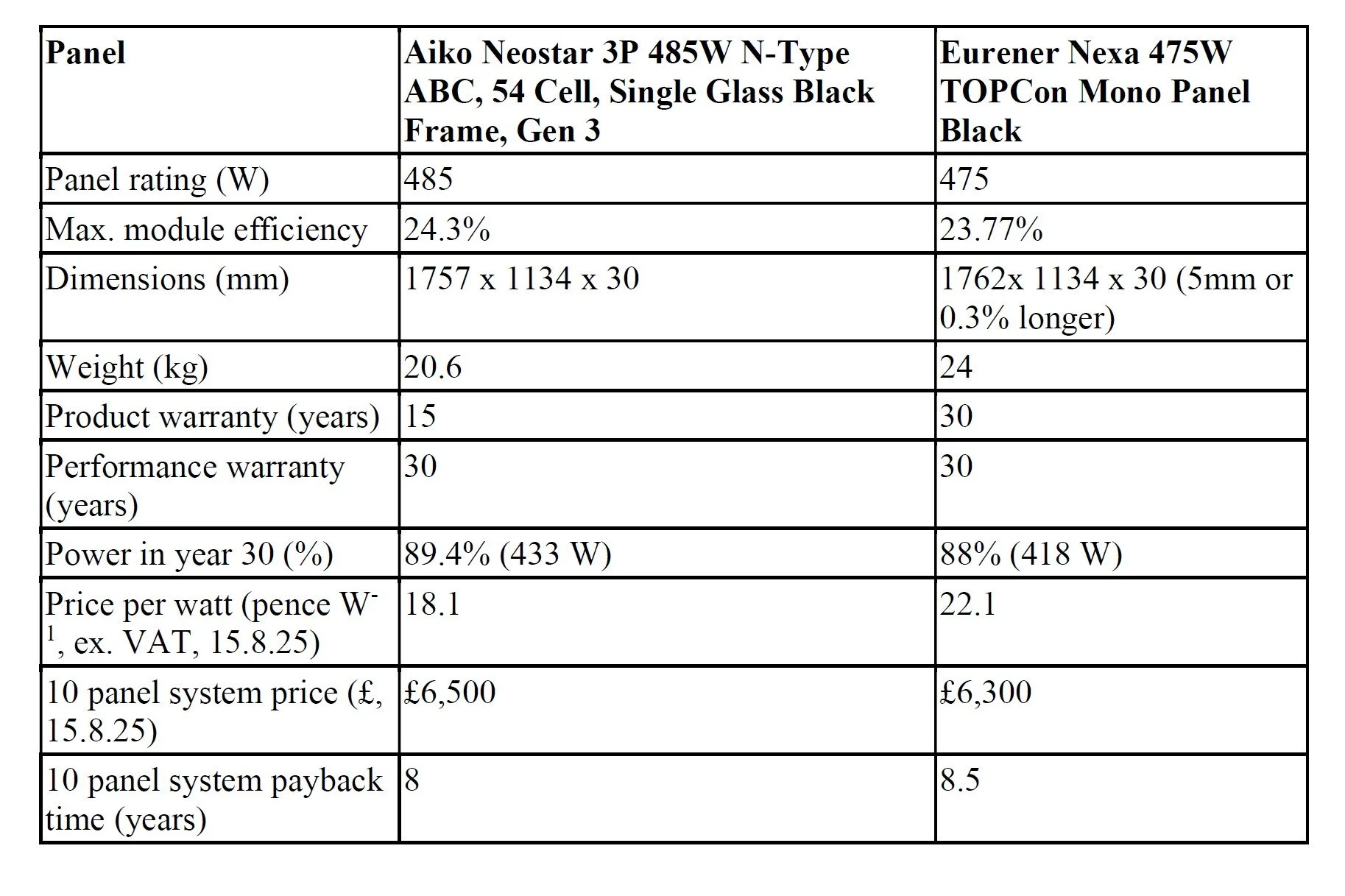
From the datasheets, we can see that the Aiko module is marginally more efficient than the Eurener, at 24.3% efficiency compared to 23.77%, likely due to Aiko’s innovative All Back Contact (or ABC) technology. This translates to around 2.5 W per panel, a small but non-zero difference. With the rate of efficiency increases in recent years, we expect that both companies will soon design new panels with even higher numbers.
Warranties can be an important factor when considering solar panels, particularly if a focus is to increase home value. While both Aiko and Eurener offer 30 year performance warranties, which cover the amount of energy that the cells will generate in the future, the Eurener product warranty is 30 years, while Aiko’s is just 15. The product warranty covers defects in the panel that could stem from its manufacturing methods or handling in the factory, such as problems with delamination or frame construction. The longer product warranty on the Eurener panels suggests they might have better longevity than their Chinese counterparts. However, it’s good to note that panels often continue performing well after their warranties expire, particularly due to the lack of moving parts that often cause failure in other modes of power generation.
Degradation over the 30 years after installation is similar between the two options, with 89.4% of the initial output expected from the Aiko panels and 88% from the Eureners. The difference between these is small, equivalent to just 5 W (expected to be worth well under £5 in export rates over a whole year!).
Solar panels and sustainability often go hand-in-hand, with many homeowners installing panels with the aim of lowering their environmental footprint and reducing carbon dioxide emissions. As such, the sustainability of the panels themselves–-not just environmentally, but also socially–-is an important factor. Being solar manufacturers, Aiko and Eurener both make efforts to operate sustainably, with Aiko winning an ESG (Environmental, Social and Governance) Transparency Award in 2023, as well as being a member of the United Nations Global Compact, a framework that aims to increase implementation and reporting of sustainable practices in business. Meanwhile, Eurener has been awarded the Ecovadis platinum medal for its sustainability, business ethics, and labour practices. The transport of solar panels from their manufacturers to homeowners’ rooves does also impact their sustainability, but is estimated to only lead to around 3% of all solar panel emissions, due to the carbon intensity of the manufacturing process.
In the real world, designs do indeed cost more when using Eurener panels compared to Aiko ones, but this difference might be small compared to the total system cost. For a 10 panel, 5 kW system, using Eurener panels costs £7994, while with Aiko panels the total cost is £7807, a difference of £187. Increasing the size of the system to 30 panels, the Eurener system costs £18203, while the Aiko system costs £17642, a difference of £561*. In both cases, the Eurener system costs 2–3% more, a relatively small difference in the grand scheme of things.
So, which panels are the best? In a nutshell, it seems that Aiko may have the edge when it comes to raw power, maximum efficiency, and minimum cost, but Eurener panels have a better warranty, and slightly stronger sustainability credentials, suggesting they might be the better option if you’re looking to add value to your home.
* These numbers are system-dependent, and will be different depending on the building that is being installed upon, as well as its surroundings. If you would like a quote, please get in touch.